South Carolina: A State of Extraordinary Experiences
Ask a South Carolinian what makes their state special, and you will almost certainly receive a passionate, wide-ranging answer that touches on history, food, natural scenery, music, college football, and the particular quality of human warmth that the state's proud people call "Southern hospitality." They are not wrong to be enthusiastic: South Carolina is, by any objective measure, one of the most richly rewarding travel destinations in the United States — a state where centuries of history, extraordinary natural landscapes, and a vibrant contemporary culture converge in ways that surprise and delight visitors who arrive expecting only beaches and Civil War battlefields.
The state divides broadly into three geographic zones that each deliver very different travel experiences. The Upstate, tucked into the Blue Ridge Mountain foothills in the northwestern corner, is a land of spectacular waterfalls, mountain lakes, state parks, and the growing metropolitan hub of Greenville — one of the most economically and culturally dynamic mid-sized cities in America. The Midlands, stretching from the rolling Piedmont hills down through the fall line to the coastal plain, encompasses the state capital Columbia, the ancient forests of Congaree National Park, the craft brewery scene of Lake Murray, and the charming small towns of the Sandhills region. And the Lowcountry and coast — discussed in depth in our beaches guide — offers Charleston, the Sea Islands, the ACE Basin, and 187 miles of Atlantic shoreline that draws travelers from every corner of the globe.
Together, these three regions compose a state of extraordinary diversity that rewards the traveler willing to venture beyond the obvious tourist trail. This guide surveys the most compelling attractions, experiences, and destinations across all three zones, providing the knowledge you need to plan a South Carolina trip that goes far beyond the ordinary.
Historic Charleston — America's Most Beloved City
No discussion of South Carolina's attractions can begin anywhere other than Charleston — consistently voted one of the world's greatest cities by Travel + Leisure, Condé Nast Traveler, and virtually every major travel publication that surveys the question. Charleston is that rarest of places: a genuinely historic city that has preserved its architectural heritage with exceptional integrity while simultaneously evolving into a world-class destination for food, arts, and hospitality that ranks among the finest to be found anywhere in the United States.
The Historic District: America's Most Intact Colonial City
Founded in 1670 as Charles Town — the first permanent English settlement in what would become the Carolinas — Charleston grew to become the wealthiest city in colonial America by the mid-eighteenth century, a prosperity built on the labor of enslaved Africans and the cultivation of rice, indigo, and Sea Island cotton in the surrounding lowcountry. The extraordinary wealth generated by this plantation economy funded the construction of some of the finest domestic and public architecture produced in colonial and antebellum America — buildings that, thanks to a combination of the city's geographic isolation, its strong preservation ethic, and the relative poverty that followed the Civil War's devastation, have survived in remarkable numbers and with exceptional integrity.
Walking the streets of Charleston's historic peninsula today — particularly the neighborhoods below Broad Street, known to residents simply as "SOB" — is to move through a living museum of American architectural history. The Battery, a promenade along the confluence of the Ashley and Cooper rivers lined with some of the most magnificent antebellum mansions in America, offers views across the harbor to Fort Sumter and the barrier islands beyond. Rainbow Row — a pastel-painted terrace of Georgian row houses on East Bay Street that has been photographed so many times it has become one of the most recognizable streetscapes in America — dates to the 1740s and represents one of the longest strips of preserved pre-Revolutionary American row housing in existence. The French Quarter neighborhood around Church Street and Queen Street preserves the physical fabric of Charleston's eighteenth-century commercial district, including the Dock Street Theatre (the site of the first purpose-built theater in the American colonies, now magnificently restored) and the Circular Congregational Church with its hauntingly beautiful cemetery.
Museums, Gardens & Cultural Institutions
Charleston's cultural institutions are among the finest in the American South. The Charleston Museum, founded in 1773, is the oldest municipal museum in the United States and houses a comprehensive collection of material culture documenting the history of Charleston and the South Carolina Lowcountry from pre-colonial times to the twentieth century. The Gibbes Museum of Art, housed in a stunning neoclassical building on Meeting Street, maintains a distinguished collection of American art with particular strength in portraits of notable South Carolinians and in the art of the American South. The International African American Museum (IAAM), opened in 2023 on the site of Gadsden's Wharf — where an estimated 40% of all enslaved Africans brought to North America first set foot on American soil — is one of the most significant new museum projects in the United States, telling the story of the African American experience with unflinching honesty and remarkable artistry.
The gardens around Charleston rival anything produced by the great gardening traditions of Europe. Magnolia Plantation and Gardens, established in the 1670s and continuously tended by the same family for more than three and a half centuries, contains the oldest public gardens in the United States and is breathtakingly beautiful at every season of the year — though the spectacle of azaleas and wisteria in full bloom against the backdrop of ancient oaks draped in Spanish moss that greets visitors in March and April is among the most beautiful sights in all of American horticulture. Middleton Place, a UNESCO World Heritage Site candidate, features the oldest surviving landscaped gardens in North America — formal geometric plantings along terraced lakes that were created in the 1740s by enslaved workers and remain magnificently intact today.
Fort Sumter: Where the Civil War Began
For students of American history, no site in South Carolina — and perhaps no site in the American South — carries the weight of Fort Sumter, the federal fort in Charleston Harbor where Confederate forces fired the opening shots of the Civil War on April 12, 1861. Fort Sumter is accessible only by the ferry service that departs from the Fort Sumter Visitor Center at Liberty Square on the Charleston waterfront and from the Patriots Point Naval & Maritime Museum in Mount Pleasant — a 30-minute crossing that provides spectacular views of the harbor, the Ravenel Bridge, and the Charleston skyline. The National Park Service rangers who staff Fort Sumter are invariably exceptional storytellers, bringing the complexity and tragedy of the Civil War's origins to vivid life in the place where it all began.
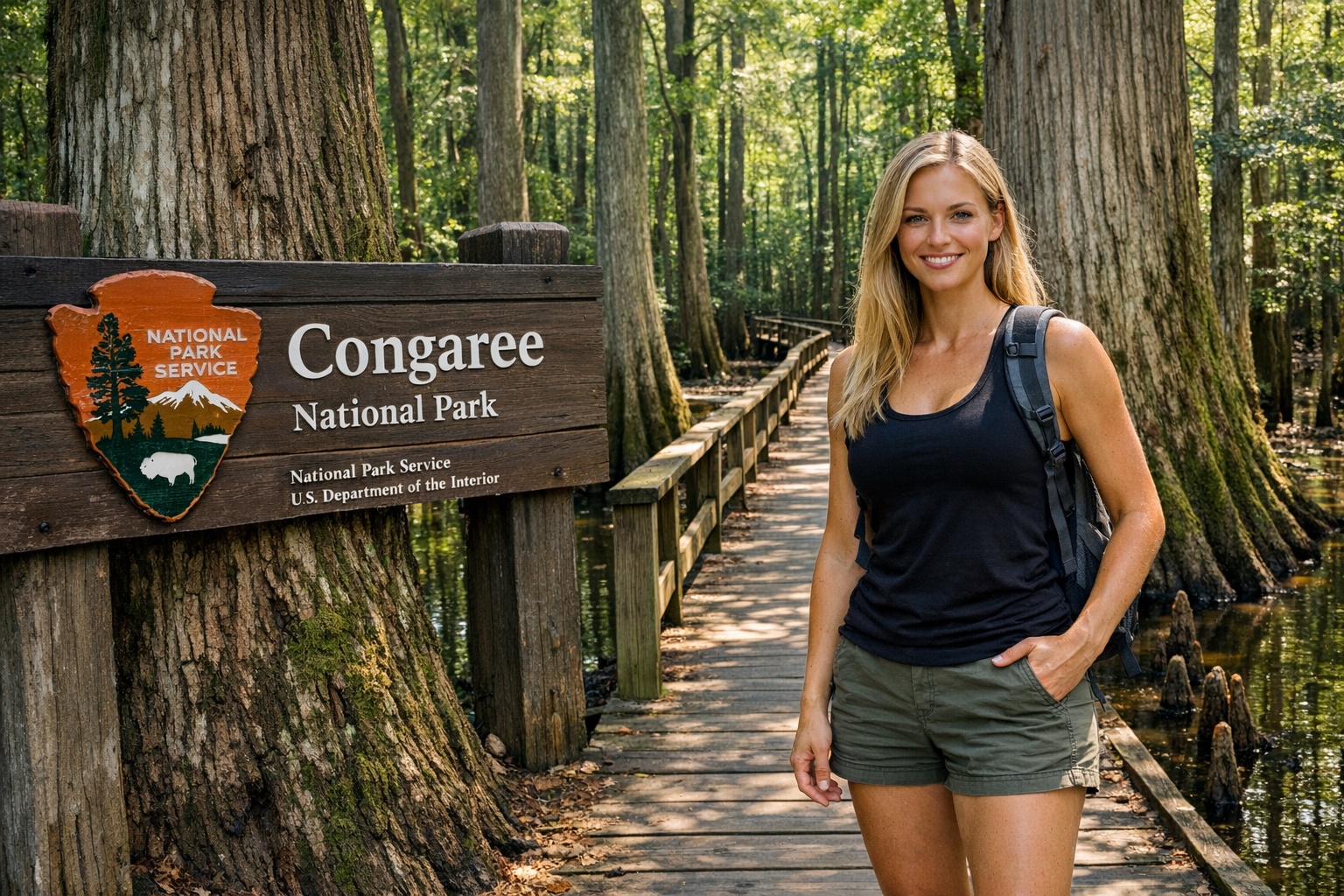
The primeval forests of Congaree National Park — South Carolina's only national park and a UNESCO World Heritage Site
Congaree National Park — An Ancient Forest Cathedral
Twenty-five miles southeast of Columbia, Congaree National Park protects the largest intact expanse of old-growth bottomland hardwood forest remaining in the southeastern United States — a landscape so extraordinary that it has been designated a UNESCO World Heritage Site, an internationally recognized Biosphere Reserve, a Ramsar Wetland of International Importance, and a Globally Outstanding Ecoregion by the World Wildlife Fund. It is South Carolina's only national park, and it is genuinely one of the natural wonders of North America.
The Trees: Champions of the Forest
What makes Congaree exceptional — what sets it apart from any other protected forest east of the Mississippi River — is the scale and age of its trees. The park protects more national and state champion trees (trees recognized as the largest known specimens of their species) than any other unit in the entire National Park System: loblolly pines that tower nearly 170 feet above the forest floor, bald cypress trees whose fluted, buttressed trunks have been growing beside the Congaree River for five centuries or more, and water tupelo, overcup oak, and cherrybark oak trees of proportions that must be seen in person to be fully comprehended.
Walking the park's elevated Harry Hampton Visitor Center boardwalk — a 2.4-mile loop that winds through the floodplain forest at tree-root level, allowing visitors to move among these giants while keeping their feet dry above the tannin-stained floodwaters below — is one of the most singular nature experiences available to any traveler in the American South. The light filters green through the high canopy; owls call from the cypress knees; and the forest's absolute silence — broken only by the drip of water, the knock of a pileated woodpecker, and the occasional distant drum of a barred owl — creates an atmosphere of profound and ancient peace that is difficult to find anywhere in the modern world.
Kayaking the Cedar Creek Canoe Trail
For visitors who want to explore Congaree from the water, the Cedar Creek Canoe Trail offers one of the finest paddling experiences in the American South. The creek winds for approximately fifteen miles through the heart of the old-growth forest, passing beneath the spreading crowns of centuries-old trees, through ancient cypress swamps where the knobby "knees" of the trees project above the dark water's surface like the fingers of subterranean giants, and past sandbars where river otters bask and great blue herons stand motionless in the shallows. The National Park Service maintains a canoe and kayak rental facility at the park during the primary paddling season, and guided canoe tours are available on select weekends — the best option for first-time visitors who want interpretation of the ecology and natural history of what they are seeing.
Congaree's firefly synchronization event — during which thousands of synchronous fireflies (Photinus carolinus) blink in coordinated unison across the forest floor for several weeks in late May and early June — has become one of the most sought-after natural phenomena experiences in the American South. The park now operates a lottery system for the limited number of vehicles permitted in the park during peak firefly evenings, reflecting the extraordinary demand from visitors who travel from across the country to witness this biological spectacle. If you are planning a trip to South Carolina in late spring, a firefly evening at Congaree should be considered a must-do experience of the highest order.
The Upstate — Waterfalls, Mountains & Greenville
South Carolina's Upstate region — the northwestern corner of the state where the Piedmont transitions into the Blue Ridge Mountain foothills — is the state's most dramatic and least stereotypically "Southern Carolina" landscape. Here, the rivers run fast and cold over ancient granite and schist, tumbling over waterfalls that rival those of the Great Smoky Mountains; trails climb through forests of mountain laurel and rhododendron to summit vistas that reveal a vast green carpet of Appalachian foothills stretching to every horizon; and a series of deep, clear lakes — Hartwell, Jocassee, Keowee, Murray — provide world-class fishing, sailing, and watersports in settings of arresting natural beauty.
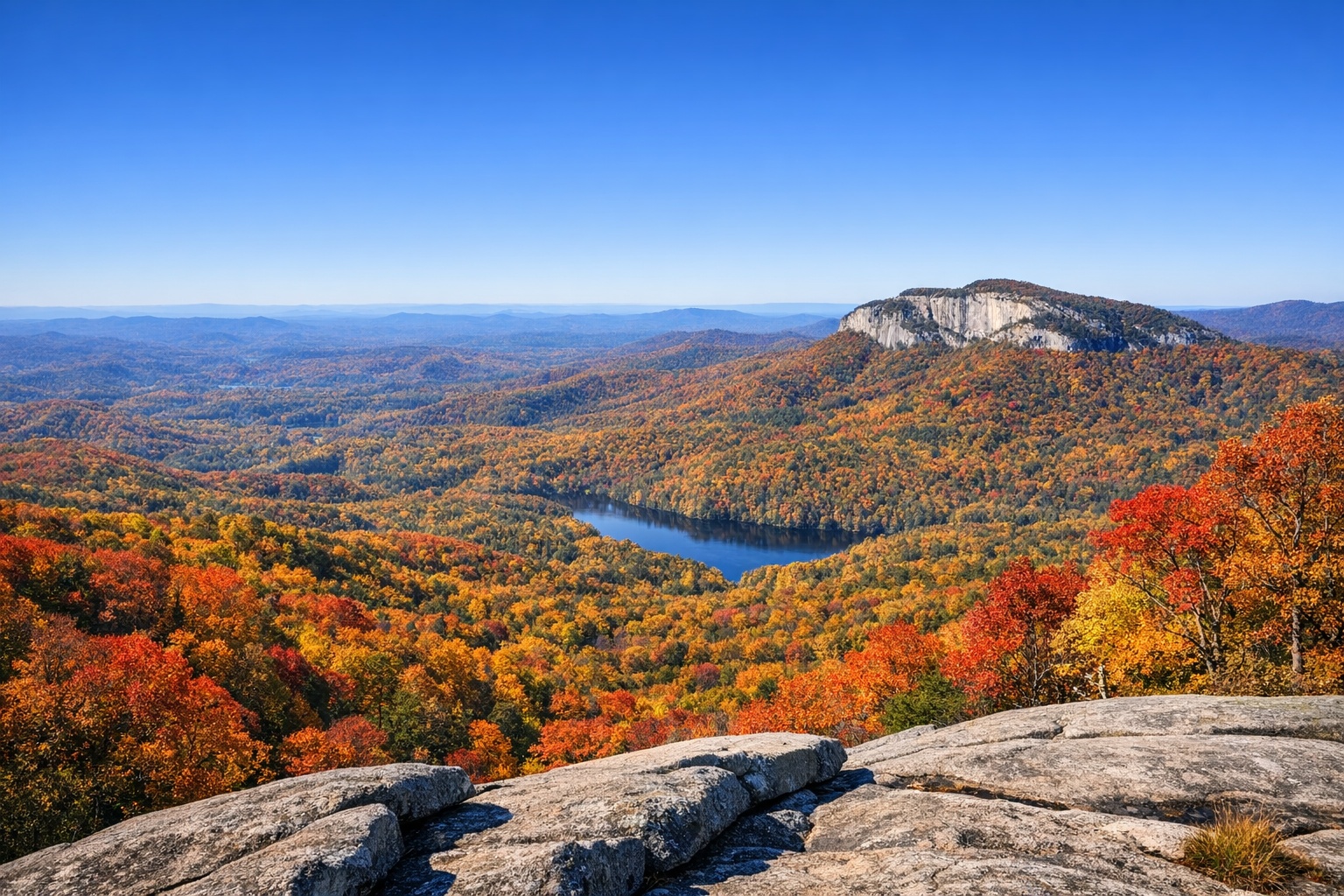
Table Rock State Park — the crown jewel of South Carolina's Upstate Blue Ridge foothills in autumn splendor
Table Rock State Park
Table Rock State Park, established in 1935 by the Civilian Conservation Corps and listed on the National Register of Historic Places for its exceptional Depression-era architecture, is widely considered the crown jewel of South Carolina's state park system. The park takes its name from the massive, bald-faced quartzite monadnock that dominates its eastern edge — a 3,157-foot mountain that rises abruptly from the surrounding Piedmont in a way that makes it appear much larger than its modest elevation suggests. The Table Rock Trail, which climbs approximately 2,000 vertical feet over 3.6 miles to the mountain's exposed summit, rewards hikers with one of the finest panoramic views in the entire Southeast: a 360-degree vista that sweeps from the rolling Piedmont to the south to the higher Blue Ridge peaks of the Carolinas and Georgia to the north and west.
Table Rock in autumn is particularly spectacular: the park's diverse forest composition — a mix of oak, hickory, sourwood, red maple, mountain laurel, and rhododendron — produces a fall color display that begins in early October on the higher elevations and works its way down through the surrounding foothills through mid-November, creating a weeks-long window of exceptional leaf-peeping opportunity that rivals anything produced in the more celebrated New England and Smoky Mountain autumn destinations.
South Carolina's Waterfall Country
The northwestern corner of South Carolina contains the densest concentration of waterfalls to be found anywhere in the state, and arguably one of the finest waterfall landscapes east of the Rocky Mountains. The Naturalista Falls complex in Oconee County — which includes the spectacular 420-foot Lower Whitewater Falls (the highest waterfall east of the Rocky Mountains), the double-plunge of Twin Falls, the elegant curtain of Issaqueena Falls, and a dozen other cascades reachable by well-maintained trails from the Whitewater Falls Recreation Area — can keep a waterfall enthusiast profitably occupied for several days of hiking. Oconee State Park, one of the original eight South Carolina state parks developed by the CCC, serves as an excellent base camp for exploration of this remarkable waterfall country, with comfortable cabin and campsite accommodations set beside a mountain lake.
Greenville — The South's Most Surprising City
No discussion of the South Carolina Upstate can overlook Greenville — a city that has undergone one of the most remarkable urban transformations in recent American history, evolving from a declining Textile Belt mill town in the 1970s and 80s to a vibrant, growing, nationally recognized hub of cuisine, arts, outdoor recreation, and economic opportunity that attracts thousands of new residents every year. The catalyst for Greenville's transformation was the opening of Reedy River Falls Heritage Park in the heart of downtown — a stretch of the Reedy River, long buried beneath a highway overpass, that was daylighted, restored, and surrounded by Falls Park, a stunning urban green space that opened in 2004 and has since been cited as a model for urban river restoration nationwide.
Main Street in downtown Greenville is a remarkable achievement in American urbanism: a pedestrian-scaled, tree-lined boulevard of boutique shops, acclaimed restaurants, art galleries, wine bars, and live music venues that functions as the active social core of a genuinely walkable downtown neighborhood. The Saturday morning Greenville Farmers Market, held in the shadow of Falls Park, is one of the finest farmers markets in the Southeast, offering local produce, artisanal cheese, fresh-baked breads, locally raised meats, and handcrafted goods from across the Upstate region. The Peace Center for the Performing Arts, a world-class concert hall and theater complex built alongside the Reedy River, brings major touring productions, the Greenville Symphony Orchestra, and nationally known musical artists to the Upstate year-round.
South Carolina's Food Culture — A Culinary Journey
South Carolina's food culture is one of the most fascinating, deeply rooted, and authentically distinctive regional cuisines in the United States — a living tradition that draws on West African cooking techniques and flavor profiles brought to the Lowcountry by enslaved people from the rice-growing regions of Senegambia, layered upon the Indigenous culinary knowledge of the state's original inhabitants and refined across centuries into a cuisine that is at once deeply Southern and entirely unique to the Palmetto State.
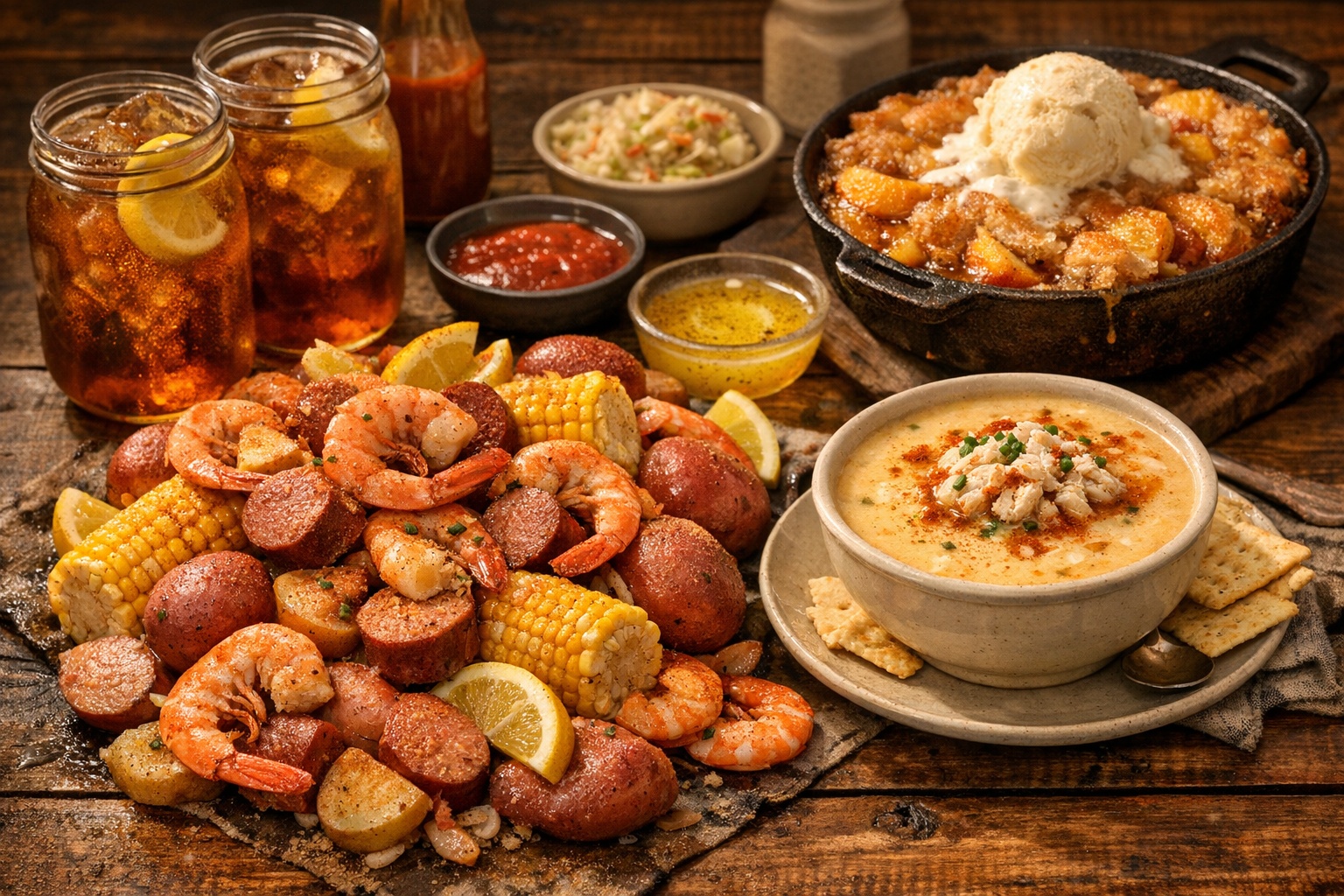
Authentic South Carolina Lowcountry cuisine — a celebration of coastal ingredients and centuries-old culinary tradition
Lowcountry Boil: The Ultimate Communal Feast
Few culinary experiences in South Carolina are as joyfully communal as a Lowcountry boil — sometimes called Frogmore Stew after the Frogmore community on St. Helena Island where the dish's modern form is said to have been codified. The preparation is wonderfully simple and endlessly variable: a large pot of seasoned, boiling water receives fresh local shrimp, smoked sausage (traditionally a spicy andouille or kielbasa), small red potatoes, sweet corn cut into chunks, and whatever other ingredients appeal to the cook — crab claws, clams, mushrooms. The whole glorious mixture is drained and tumbled directly onto a newspaper-covered table or a sheet of brown paper spread on a folding table outdoors, and everyone digs in with their hands. No dish better captures the spirit of South Carolina's coastal culture — its informality, its generosity, its absolute insistence on freshness and quality of ingredients, and its conviction that eating is an essentially social act best conducted in the company of family and friends.
She-Crab Soup: Charleston's Crown Jewel
She-crab soup is to Charleston what clam chowder is to New England or gumbo is to New Orleans: a deeply regional dish that concentrates within a single bowl the essence of a coastal culinary tradition. The soup's base is a rich, cream-enriched seafood bisque made with the sweet meat and, traditionally, the roe (eggs) of female blue crabs — the "she" of the name. The roe contributes a distinctive richness and a subtle oceanic flavor note that distinguishes authentic she-crab soup from the many inferior imitations produced outside the South Carolina Lowcountry. A splash of dry sherry — added by the cook during the simmering process and, by tradition, by the diner at the table from a small silver cruet — provides the aromatic counterpoint that ties the whole composition together. The best she-crab soup in South Carolina is served at a handful of legendary Charleston restaurants where the recipe has been refined over multiple generations and the crab is sourced daily from local crabbers who work the adjacent tidal creeks and estuaries.
Barbecue: The Great SC Sauce Debate
South Carolina's barbecue tradition is older, more geographically varied, and more genuinely contested than that of any other state in the American South — which is saying a great deal. The state is the only one in the nation that encompasses all four major American barbecue sauce styles within its borders: the tomato-and-vinegar sauces of the Pee Dee region; the heavy, tomato-based sauces of the Grand Strand; the vinegar-and-pepper sauces of the Upstate and western Midlands; and the tangy, yellow mustard-based sauce of the central Midlands — a tradition descended from the German immigrant settlers of the colonial era and practiced in its most authentic form in a corridor stretching from Orangeburg to Columbia to Newberry. The mustard sauce tradition, in particular, is virtually unique to South Carolina and represents a culinary heritage found nowhere else in the world — making it a mandatory tasting experience for any serious barbecue enthusiast.
South Carolina's pit masters are rightly celebrated throughout the barbecue world. Scott's BBQ in Hemingway, operated by the Scott family for four generations using whole-hog, wood-pit barbecue techniques unchanged for a century, has been featured in every major food publication and draws pilgrimage visitors from across the country. Sweatman's BBQ near Holly Hill — open only on Fridays and Saturdays — serves whole-hog mustard-sauce barbecue cooked over live oak coals in a converted gas station that has become a sacred site for barbecue devotees. These are not merely restaurants; they are custodians of a living culinary tradition that constitutes a form of intangible cultural heritage worthy of preservation and celebration.
Fresh Peaches: A South Carolina Summer Ritual
South Carolina is the second-largest peach-producing state in the United States — a fact that surprises many visitors who associate peach production primarily with Georgia. The Palmetto State actually produces more peaches than the Peach State in most years, and the peaches grown in the sandy soils of the Midlands and Piedmont regions are arguably the finest in the country: intensely fragrant, heavily freestone, dripping with nectar, and possessed of a skin-to-flesh balance and a sugar-to-acid ratio that makes a perfectly ripe South Carolina peach one of the most transcendent experiences that seasonal eating can provide. The peach harvest runs from late May through mid-September, with different varieties coming into peak ripeness in succession throughout the summer. Roadside fruit stands throughout the Midlands — particularly along I-26 in the Batesburg-Leesville corridor — sell fresh-picked peaches by the peck and bushel, and the tradition of stopping for a bag of peaches on the way home from the beach is as deeply embedded in South Carolina culture as watching Gamecock football or sitting on the front porch at dusk.
Gullah Geechee Culture — South Carolina's Living Heritage
The Gullah Geechee people — descendants of the enslaved West Africans who worked the Sea Island cotton, rice, and indigo plantations of the South Carolina and Georgia coast — constitute one of the most culturally distinctive and historically significant communities in the United States. Because of their geographic isolation on the Sea Islands, which limited contact with mainland white culture and facilitated the preservation of African linguistic and cultural traditions across multiple generations, the Gullah Geechee developed and maintained a unique language, cuisine, spiritual practice, artistic tradition, and communal culture that represents the most direct surviving link in the United States to sub-Saharan African cultural heritage.
The Gullah Geechee Cultural Heritage Corridor, established by Congress in 2006, stretches along the Atlantic coast from Wilmington, North Carolina, to Jacksonville, Florida, encompassing the entire South Carolina Sea Island coast within its boundaries. Within South Carolina, the most important Gullah Geechee cultural sites include Penn Center on St. Helena Island — established in 1862 as one of the first schools for freed Black people in the American South and later used by Dr. Martin Luther King Jr. as a retreat for planning civil rights strategy — the community of Daufuskie Island (accessible only by boat, with no bridges and no cars), the coastal communities of Beaufort County, and the neighborhoods of Johns Island and Wadmalaw Island near Charleston where Gullah fishing and farming communities have maintained their distinctiveness into the twenty-first century.
Visiting Gullah Geechee cultural sites with appropriate respect and curiosity — engaging with the community-operated cultural centers and guided tours rather than treating the culture as a spectacle — is one of the most rewarding and intellectually enriching travel experiences available in South Carolina. The food, the sweetgrass basket-weaving tradition (conducted by Gullah women artisans at roadside stands along US Highway 17 north of Charleston in an unbroken commercial tradition stretching back to the antebellum period), the music, the language, and the extraordinary resilience of the Gullah Geechee community in the face of centuries of oppression and more recent displacement pressures from coastal development all combine to make engagement with this living culture a profound and unforgettable experience.
Arts, Festivals & Outdoor Adventures
South Carolina's calendar of arts festivals, outdoor events, and adventure tourism opportunities ensures that there is genuinely no bad season to visit the Palmetto State — though the mild springs and warm autumns attract particular appreciation from travelers seeking pleasant weather, manageable crowds, and full access to the state's extraordinary range of outdoor activities.
Spoleto Festival USA, Charleston
Spoleto Festival USA — held annually in Charleston during seventeen days in late May and early June — is one of the most comprehensive and artistically ambitious performing arts festivals in the world. Founded in 1977 by Pulitzer Prize-winning composer Gian Carlo Menotti as the American counterpart to his Festival dei Due Mondi in Spoleto, Italy, the festival presents more than 150 performances of opera, theater, dance, orchestral music, chamber music, jazz, and spoken word in both indoor and outdoor venues throughout historic Charleston. The variety and quality of the programming is extraordinary: a single festival season might encompass a fully staged production of a twentieth-century opera in the Dock Street Theatre, an outdoor symphony concert on the lawn of Middleton Place, a world premiere of a contemporary dance work in a former warehouse space, and a late-night jazz improvisation in a historic church. For two and a half weeks, Charleston transforms into one of the world's most concentrated performing arts destinations, drawing performers and audiences from across the globe.
Hiking, Paddling & Mountain Biking
South Carolina's network of state parks, national forest lands, and wildlife management areas provides an extraordinary range of outdoor recreational opportunities that extend far beyond the beaches. The Palmetto Trail — a 500-mile hiking trail that traverses the state from the Blue Ridge Mountains to the Atlantic coast, passing through every geographic zone from mountain forest to coastal plain — is one of the most ambitious long-distance hiking trail projects in the American South and offers thru-hikers and day-trippers alike access to landscapes that range from breathtaking mountain vistas to ancient cypress swamps. The Foothills Trail, which runs for 76 miles through the mountain region of Oconee and Pickens counties and connects Table Rock State Park to the Chattooga River National Wild and Scenic River corridor, is widely considered the finest multi-day hiking trail in South Carolina and one of the best mountain trails in the entire Southeast.
Mountain biking has exploded in South Carolina over the past decade, driven by a combination of trail-building investment, geographic diversity, and a strong community of passionate riders. Dupont State Recreational Forest — just across the North Carolina border but easily accessible from the South Carolina Upstate — has developed a network of world-class mountain bike trails that have attracted national attention. Closer to home, the Lake Hartwell and Calhoun Falls State Park trail networks and the Harbison State Forest trail system outside Columbia offer excellent riding across a range of difficulty levels for cyclists of every experience and ability level.
South Carolina Wine & Craft Beer Scene
South Carolina's craft beverage scene has grown from a handful of pioneering operations in the early 2000s to a robust industry encompassing more than 60 craft breweries, a growing number of wineries in the Upstate's Yadkin Valley extension, and an emerging distillery scene that has produced nationally recognized spirits. The Greenville craft brewery corridor — anchored by Trophy Brewing, Swamp Rabbit Brewing, Birds Fly South, and a dozen other taprooms within walking distance of downtown — has established the city as one of the Southeast's premier craft beer destinations. Charleston's King Street and its surroundings host another concentration of excellent craft taprooms and wine bars. The Friday evening Pickens County wine trail, which connects a cluster of small wineries producing muscadine, vinifera, and hybrid wines from locally grown grapes in the Upstate foothills, offers a quintessentially South Carolina alternative to the more famous wine routes of Napa and Willamette valleys.
📅 South Carolina Annual Events Calendar
- March–April: Cherry blossom season, Charleston gardens in bloom, azalea displays
- April: RBC Heritage PGA Tour golf, Hilton Head Island
- Late May–June: Spoleto Festival USA, Charleston | Firefly season, Congaree
- June–August: Beach season in full swing, all coastal destinations
- September: MOJA Arts Festival, Charleston (African American arts & culture)
- October: Peak fall foliage, Upstate | SC State Fair, Columbia
- November: Beaufort Food & Wine Festival | Lowcountry oyster season begins
- December: Charleston's Festival of Lights | Holiday openings, historic plantations
Whatever season you choose to visit South Carolina, whatever interests drive your travel, and whatever budget you bring to the Palmetto State — you will find more than enough to fill your days with beauty, discovery, and the particular pleasure of encountering a place that takes deep and genuine pride in sharing itself with visitors. South Carolina has been welcoming travelers for more than three centuries, and the warmth and generosity that characterize its people have not diminished with time. Come for the beaches, the history, or the barbecue — stay because, as countless visitors have discovered before you, South Carolina has a way of claiming a corner of your heart that it never entirely releases.
Plan Your South Carolina Adventure
Explore our complete guides to SC's stunning beaches and world-class universities.
